How to Enroll
Applications for degree programs are accepted only for the Fall semester. New students are not accepted for Spring semester.
Applications for the Service Dog Training Seminar are accepted through June.
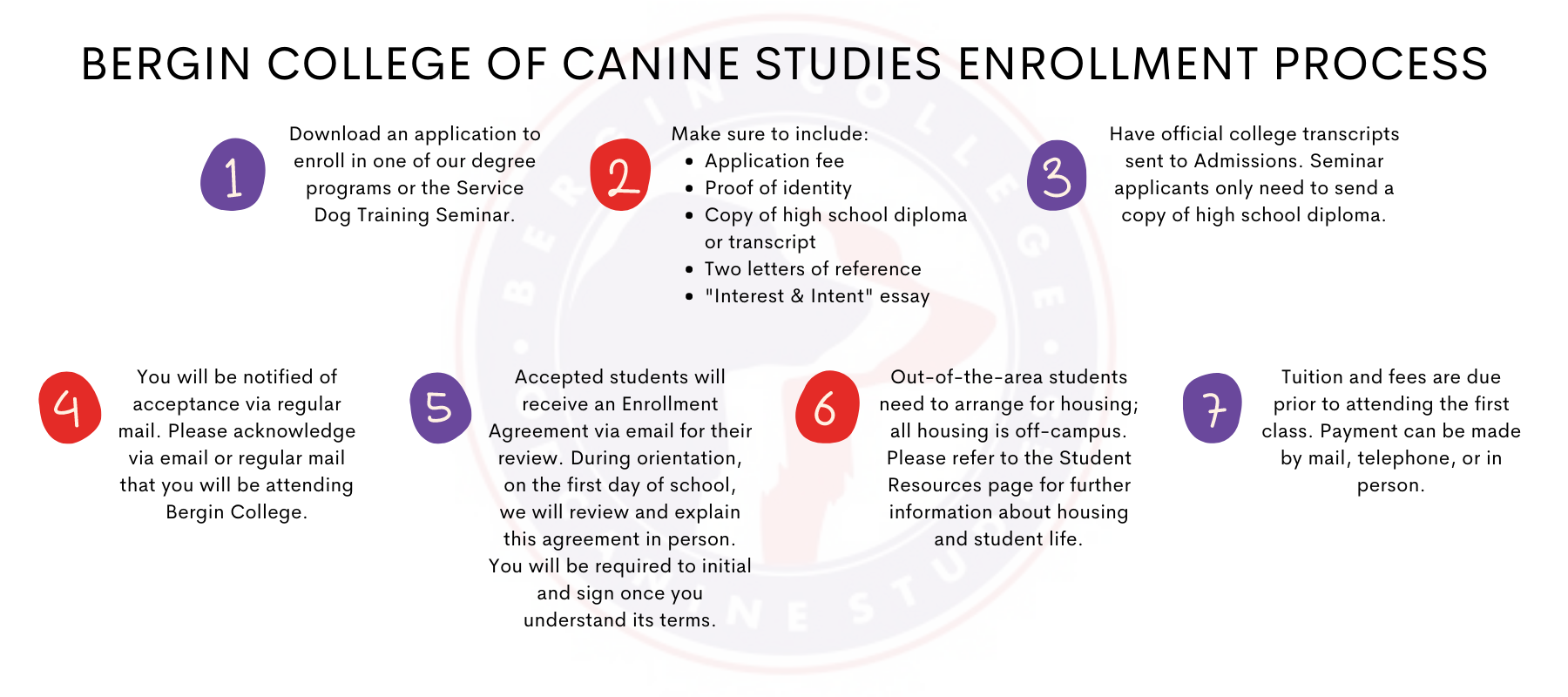
-
To the College - General Policy
Bergin College of Canine Studies will accept college level transfer credit to meet program expectations, with presentation of an official transcript of record from the awarding institution.
Credit must:1) have been completed at a U.S. Department of Education accredited institution;
2) be comparable to coursework required in the program of enrollment;
3) have been completed with a grade of “C” or better, for undergraduate programs, and a “B” or better for graduate level programs.
Students may be required to provide: a catalog record for the school where credit was earned and/or a course outline, establishing that learning outcomes for the coursework are comparable to that required in the course for which it will substitute. General education coursework must be identified within the broad categories of traditional general education as required by Bergin College.
Decisions on award of transfer credit is made by the Chief Academic Officer or assigned staff, in consultation with appropriate faculty. Academic credit awarded through “transfer” is not calculated in the overall cumulative GPA for the College, nor is credit applicable toward confirmation of Satisfactory Academic Progress. -
From the College
Notice concerning Transferability of Credits and Degrees earned at our school:
The transfer of credit you earn at Bergin College of Canine Studies is always at the discretion of the receiving school, generally depends on comparability of curricula, and may depend on comparability of accreditation. Acceptance of the degree you earn in Assistance Dog Education, Canine Studies or Human-Canine Life Sciences is also at the complete discretion of the institution to which you may seek to transfer. If the credits or degree that you earn at this institution are not accepted at that institution to which you seek to transfer, you may be required to repeat some or all of your coursework at that institution. For this reason, you should make certain that your attendance at this institution will meet your educational goals. This may include contacting an institution to which you may seek to transfer after attending Bergin College of Canine Studies to determine if your credits or degree will transfer.
-
International Students
Bergin College is authorized by the U.S. Department of State to participate in the Student and Exchange Visitor Program (SEVP).
INTERNATIONAL TRANSCRIPTSForeign student applicants must include with their application an English transcript of general education and elective course requirements. Remember, the transfer course requirements are different depending on the program or certificate; please read catalog carefully. Proof of education requires that all non-U.S. educational records must meet the following requirements:
a. The forms must be in Englishb. Official transcripts for credits earned at an institution of higher education outside of the United States must be accompanied by a credit evaluation in English provided by an international credit evaluation service.
INTERNATIONAL STUDENTS AND PROFICIENCY IN USE OF THE ENGLISH LANGUAGEA student educated out-of-country and/or with instruction in a language other than English, is required to submit documentation regarding English proficiency and transfer coursework. International students whose native language is not English and who did not attend a secondary school or college where English was the language of instruction must demonstrate language proficiency by one of the following methods:
a. Submit the score of the Test of English as a Foreign Language (TOEFL) or Duolingo English Test taken in the previous 12 months.
Recommended TOEFL score for successful education in our College is 527-530 (paper-based), 197 (computer-based), and 71 (Internet-based). Recommended Duolingo English Test score for successful education in our College is 95/160. Bergin College of Canine Studies accepts the recommended scores.b. Submit transcript from previous college or university in United States.
c. Submit transcript from English Language School in United States.
INTERNATIONAL STUDENTS AND IMMIGRANT VISASStudents must follow the procedures regulated by their M-1 visa status. Immigrant visa residents must provide their assigned “A-number” or verification of legal residency in California. Bergin College does not offer visa services.
The College is approved to offer I-20 immigration forms for full time students who meet their country’s criteria. Please contact us for details.
Step 1: Classes are taught in English, so proficiency is critical. Applicants whose native language is not English and who did not attend a secondary school or college where English was the language of instruction are required to provide their TOEFL or Duolingo test results.
Step 2: Seminar (7 weeks) certificate, Associate (8 months) degree and Bachelor’s (2 years) degree programs require a student visa.
Step 3: After you have been accepted, a Bergin College administrator will send the Form I-20.
Step 4: When you receive the I-20, you can apply to the U.S. Department of State for a to M-1 visa (Student Status for Vocational Student) to. Information about issuing the visa is available at U.S. Department of State website (www.state.gov). The process of issuing a visa could take a few months.
Step 5: When you get your M-1 visa from the American Embassy in your country, you can enter the United States 30 days prior to the program start date listed in the Form I-20. You have to have in your possession both the I-20 and your passport with I-94 (visa) to get into the United States.
(a) Applicant refers to an individual who is in the process of applying or whose application is currently being reviewed by the College;
(b) Provisionally accepted refers to the status of an applicant who has applied to the College but whose information is not yet complete or who has not met all the requirements, or whose case is being reviewed with the potential of waiving or substituting other experience for the missing admissions requirement(s);
(c) Student refers to an applicant who has been accepted to attend or who is currently attending College courses;
(d) Denied refers to the status of an applicant who did not meet the minimum admission requirements for their selected program and was denied admission;
(e) Academic probation refers to the status of a student whose College grade point average falls below an acceptable 2.00 either at mid-semester or at the semester’s end. Academic probation status must be cleared by the next evaluation point. Students who were accepted into a College degree program with a post-secondary GPA of less than 2.00 must successfully attain and maintain a 2.00 or higher GPA during their enrollment at the College;
(f) Academic disqualification refers to the status of a student who fails to clear his/her academic probation status within the probationary period.